ABOUT US
SOLUIOTECH (Solution Using Internet of Things and Technology) is a community of robotics enthusiasts. Our mission at SOLUIOTECH is to create innovative solutions using the Internet of Things (IoT) and technology to solve everyday challenges faced by individuals and industries.
ROVER4MARS challenge
The challenge is to design and build a Mars rover prototype.
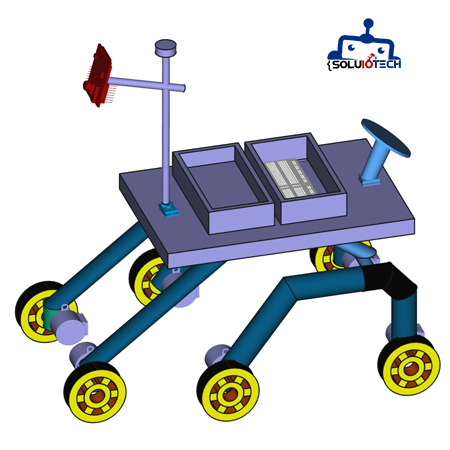
Our rover is based on the models of NASA’s: curiosity and perseverance. It is therefore equipped with six (6) non-steerable drive wheels, to facilitate design and reduce manufacturing costs. It is able to ride on sandy and rocky terrain and is capable of climbing obstacles of a certain size: 30cm Max, thanks to its structure type rocker-bogie, unlike the 4 wheels rovers.
Environmental constraints: It can withstand temperatures ranging from -25°C to 130°C (due to the L298N which has the lowest values in our assembly.) Electronic components are protected from water and dust, but the wheels must not pass through water because of the engines.
Technical constraints: it has a weight of 25Kg empty and is powered by 2 12V batteries recovered from 2 Uninterruptible Power Source (UPS) damaged. Communication and remote control are provided by a WIFI network, using the HTTPS protocol. Its dimensions are 36x32*85cm.
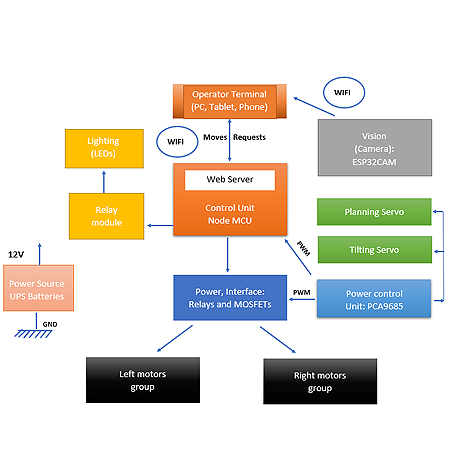
The heart of our rover is a webserver installed on a NodeMCU which communicates with the operator via its WIFI terminal, and assures the movements of the motors through the power interface. Two servos are used to control the orientation of the camera in panning and tilting mode. To assure the vision of the rover, an ESP32-CAM is mounted on top of the support plate. We use a 12V battery to power all components.
System description
Mechanical Structure
Subsystem Description:
General Rover schematic:
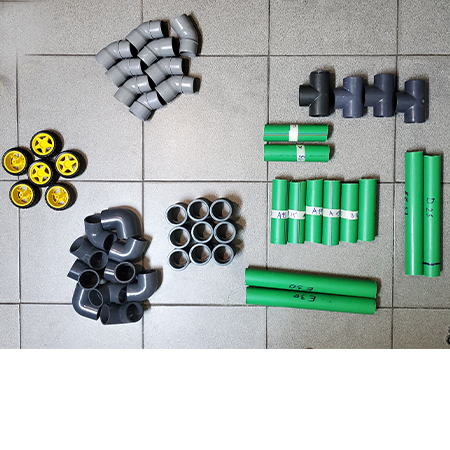
Designed to traverse endless terrains, the lightweight and strong structure used in our rover which comprises of a locomotion sub-system. The body of the rover consists entirely out of PVC pipes, which provide the perfect balance between lightness, strength and flexibility.
Why this choice: We chose PVC pipes because they are easily assembled and also a cheap material to buy, very important on testing project. I opted for car window regulator motors because they offer enough power and are a common resource. Moreover, they are easy to integrate into a hobby robotics design.
Locomotion
Subsystem Description:
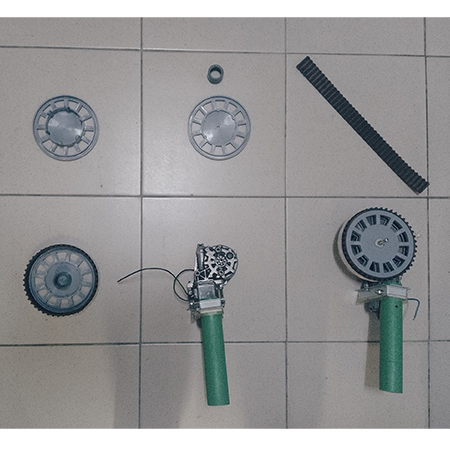
Each wheel is driven by a car window regulator motor providing the movement.
And is mounted with the top of PVC polypropylene siphon 15*15cm and toothed belt to make it all terrain.
Why this choice:
We chose PVC polypropylene siphon because of:
- Its Lightweight, its Resistance and it’s easy to work with.
we chose car window regulator motor because:
- Its strength, its high torque, it can work from 5 to 12V, it’s availability, It’s recyclable, low price.
Components used:
PVC pipes for the structure
Car window regulator motors
All-terrain wheels
PVC pipe connectors and joints
Power
Subsystem Description:
Such a power subsystem is crucial in order to have the required energy for rover operation. We are presently using just a standard UPS battery of sorts which can provide us with sufficient amount of energy we need, mounted on the rover platform. These can be charged with a standard charger or solar panel mounted on the rover
Why this choice:
This use of a readily available battery has the advantage that we can keep costs low, while at the same time providing enough energy capacity to perform testing and initial development phases for our rover.
Components used:
Rechargeable battery
Power control box
Communication
Subsystem Description:
Communication Subsystem Communicates through a web interface with the rover operator by a WIFI link.
Why this choice:
we chose this technology, because all modern devices have this feature.
So, we can communicate and control the rover by a PC, smartphone, tablet which all have a navigator. It allows a wireless and unlimited distance control if the rover is connected to internet.
Processing
Subsystem Description:
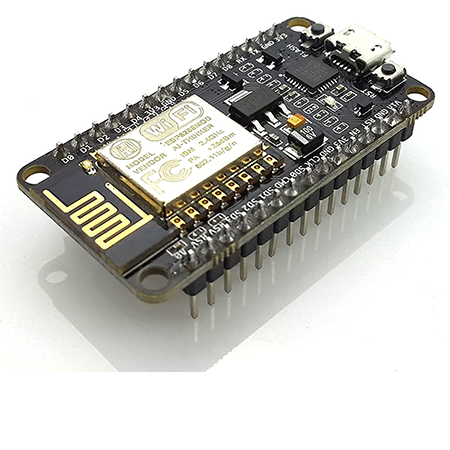
We chose the NodeMCU module to process the requests from the rover operator.
Why this choice:
It’s more powerfull than Arduino Nano, Mega…, has WIFI integrated, can host a web server, less expensive, available, is widely used for IoT system, consume less.
A NodeMCU module enables communications with, and remote management of the rover.
Components used:
NodeMCU module
Integrated Wi-Fi antennas
Control & Monitoring Through Web-based Interface
Vision
Subsystem Description:
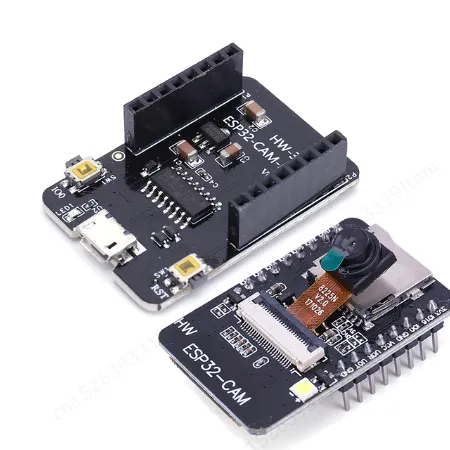
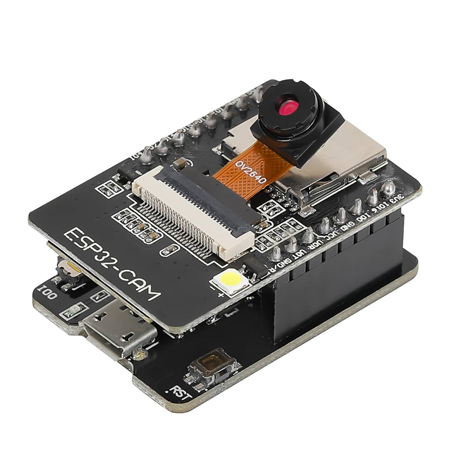
The vision subsystem, is assured by an ESP32-CAM to capture images and videos of the terrain explored by the rover.
Why this choice:
The ESP32-CAM was the perfect choice, since it’s wireless and has a camera capability together making possible to stream live video via a web interface.
Its High-resolution cameras allow for detailed images, crucial for terrain analysis and autonomous navigation of the rover. It’s lightweight, has WIFI and BT, available in Benin, less expensive, powered by 5V source.
(This makes it way easier to design a system with good and predictable performance.)
Components used:
ESP32-CAM